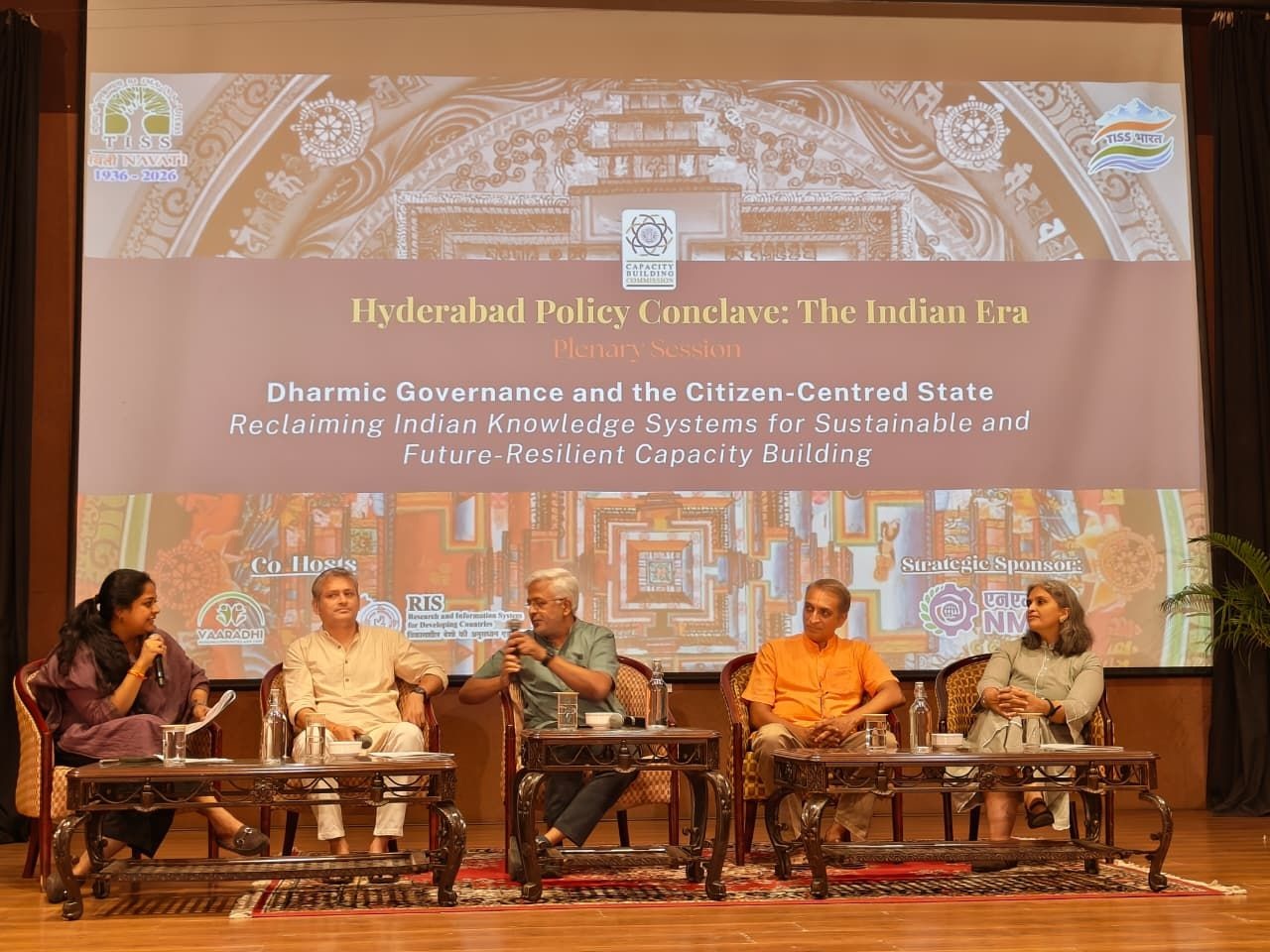
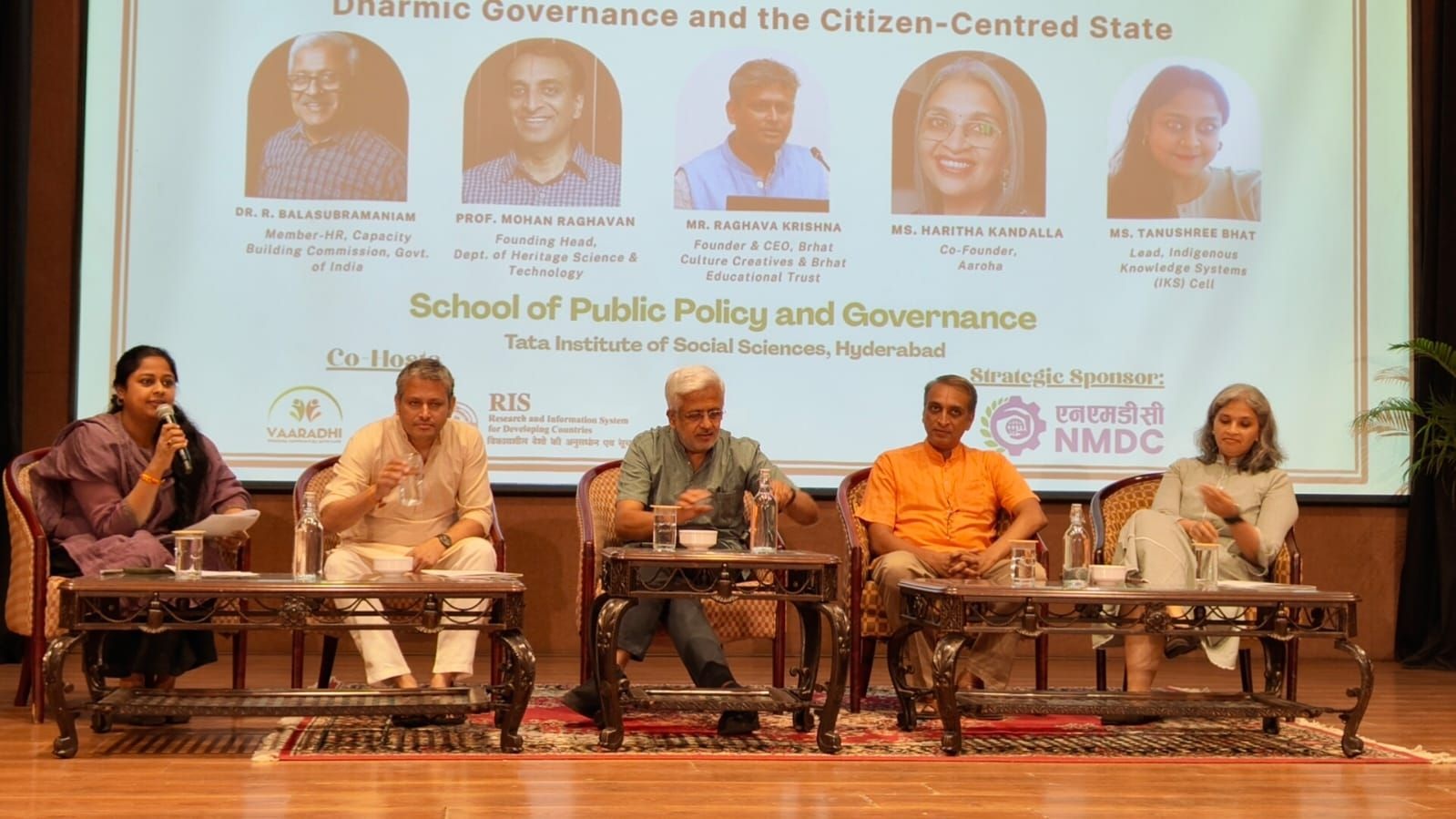
The Indian ERA: Hyderabad Policy Conclave, the Capacity Building Commission convened a powerful panel on Dharmic Governance and the Citizen-Centred State—less a conference session, more a reflection on what changes when governance is guided not just by efficiency, but by wisdom.
Raghava Krishna, Bṛhat, set the philosophical foundation, describing Dharma as a living ethical framework that reshapes the relationship between power, duty, and the citizen.
Prof. Mohan Raghavan, IIT Hyderabad, drew from the Mahabharata, Arthashastra, and the Ramayana to show how Indian civilisational thought offers both ethical depth and administrative clarity—where authority is understood as trust.
Dr. R. Balasubramaniam, Member, CBC, connected these ideas to practice, emphasising that Nagarik Devo Bhava is not a slogan but a design principle. Through the Rashtriya Karmayogi Jan Seva Programme, values-based capacity building is being implemented at scale across civil services.
Haritha Kandalla, Aaroha, reflected on how state interaction is experienced as either care or authority, highlighting IKS as a way to reframe power as responsibility and governance as relational.
The discussion closed with an important question: how do we ensure cognitive decolonisation remains rigorous and does not become rhetoric? The answer was clear—Dharmic Governance begins with self-work.
We also launched our research article Dharmic Governance & the Citizen-Centred State, authored by Dr. R. Balasubramaniam and Tanushree Bhat.
The Indian ERA: Hyderabad Policy Conclave, the Capacity Building Commission convened a powerful panel on Dharmic Governance and the Citizen-Centred State—less a conference session