Rajat Srivastava, Capacity Building Commission:
A reflection on Bharatiya Ethos of Continuous Learning, Discipline and Growth
Learning as a Quiet Constant
Observe a two-year old child for five uninterrupted minutes. She picks up a stone, turns it over, drops it, picks it up again. She is not being taught. She is not preparing for an examination. She is simply doing what every living being does naturally -she is learning. In our homes, our kitchens, our offices, our paddy fields, this quiet miracle unfolds every single day. A new employee searches online for how to file an income tax return. A village headman adapts to a changed land record system. A cab driver memorises a new shortcut route. None of them would call this 'learning.' But that is exactly what it is.
Psychology defines learning as 'a relatively permanent change in behaviour, knowledge, or mental potential resulting from experience, practice, or observation.' It covers habits, motor skills, and emotional responses - how we, as individuals, adapt to our ever-shifting world. But this definition, though precise, feels a little cold when placed against the warmth of daily Bharatiya lifestyle. Because in this land, learning has never been a mechanical process. Ask yourself: is it only information when a grandmother teaches her granddaughter to roll a perfect roti? Is it only skill transfer when a fisherman reads the wind before casting his net? There is something deeper happening there — something our civilisation has always called Sādhana.
Sādhana, at its simplest, is intentional, disciplined, and continuous pursuit. What we casually call 'learning' is, in its truest sense, Sādhana-a deeper, more purposeful journey than just acquiring facts. And this distinction matters more today than ever before.
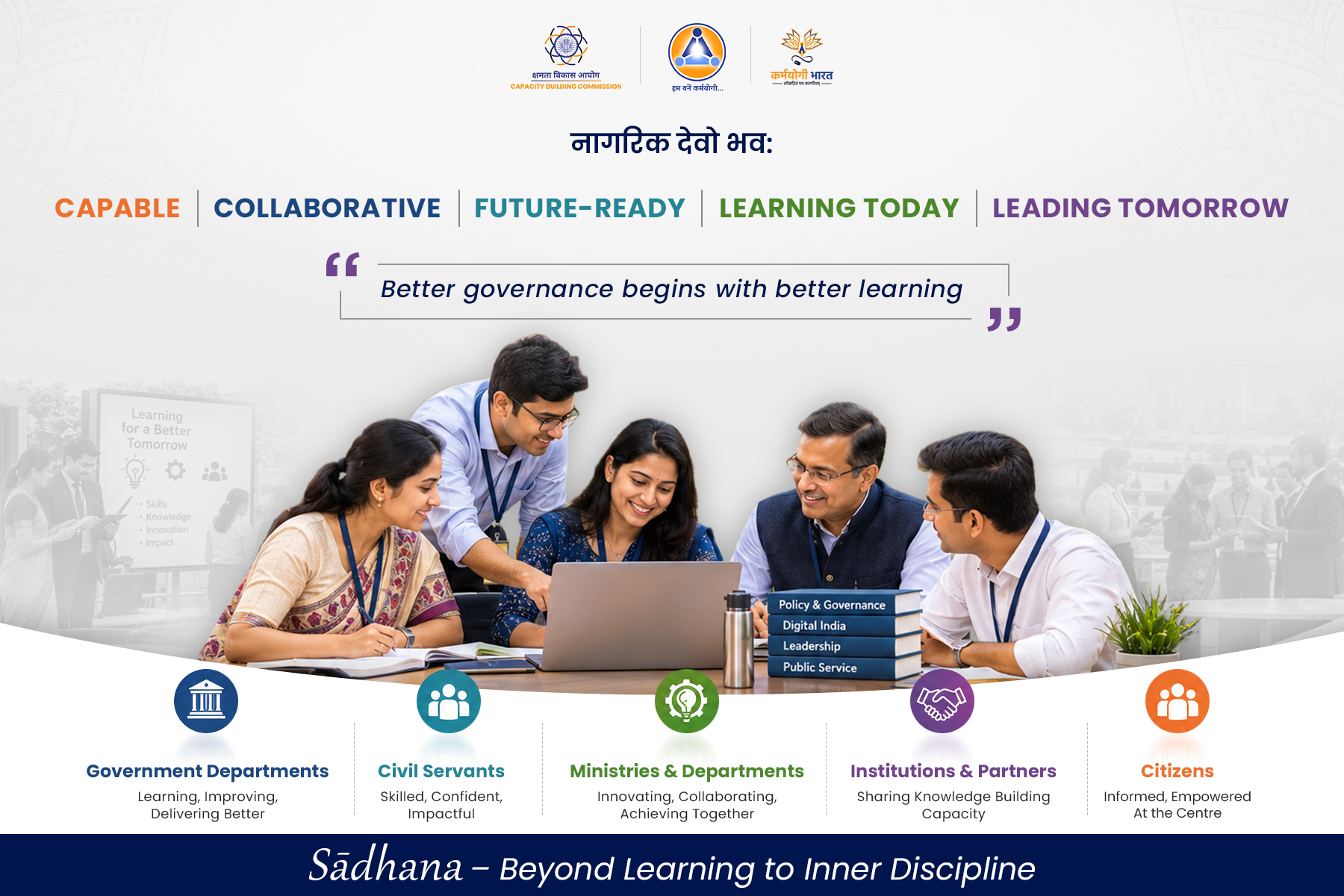
Sādhana – Beyond Learning to Inner Discipline
The word Sādhana comes from the root 'sādh' - meaning to go straight to the goal, to accomplish, to perfect. In the Bharatiya philosophical tradition, Sādhana is not merely an activity. It is a way of being. A classical musician who practises scales for three hours every morning before breakfast is not rehearsing — she is shaping her very consciousness. A wrestler at an akhara who wakes before sunrise is not merely building muscle — he is building character. Sādhana is the bridge between information and transformation.
Consider the contrast: information is what we read in a book. Transformation is what changes how we see the world after reading it. Information tells us that honesty is a virtue. Sādhana makes us honest even when no one is watching. This is why our ancients said: 'Vidyā dadāti vinayam' — true knowledge gives humility. It does not inflate; it deepens. As our Hon’ble Prime Minister noted while addressing the G20 Education Ministers, reciting this very shloka: from humility comes worthiness, from worthiness comes wealth, and from wealth, the ability to do good. Learning, in the Bharatiya sense, has always been a moral and spiritual journey, not merely an intellectual one.
This is what made the Karmayogi Sādhana Saptah - in April 2026 — far more than a week of online courses and webinars. Organised by the Capacity Building Commission under Mission Karmayogi, it was not merely as a 'learning week' but it acted as a national pause for conscious self-improvement. Its full name says it all: Strengthening Adaptive Development and Humane Aptitude for National Advancement. The word 'humane' is significant — it reminds us that at the heart of all capacity building is a human being, not just a government functionary.
Roots in Bharatiya Civilisation – Learning as a Sacred Duty
There is a reason why the Gurukul system lasted thousands of years. In that ancient model, a student lived with the Guru — ate with him, swept his courtyard, tended the cattle, and in between all of this, absorbed knowledge. Learning was not compartmentalised into a fixed timetable. It was woven into every hour of existence. Chanakya, the great strategist of the Mauryan era, understood that governance without learning was governance destined to collapse. His Arthashastra is, among other things, a rigorous course in administrative excellence - demanding that rulers study, adapt, and remain perpetually curious.
King Ashoka offers perhaps the most dramatic example of learning as transformation in Bharatiya history. After the bloodshed of the Kalinga war, he did not simply feel remorse -he learned from it. He changed. He translated that inner change into a new philosophy of governance built on Dhamma, compassion, and citizen welfare. This is Sādhana in its most powerful form: experience becoming wisdom, and wisdom becoming policy.
The Tamil classic Tirukkural, composed over two millennia ago, devotes an entire chapter to the imperative of lifelong learning. Thiruvalluvar wrote that a man of learning is welcomed everywhere, as rain is welcomed by a parched earth. The Chola empire institutionalised knowledge - their temple complexes were simultaneously centres of worship, administration, art, and learning. Bharat never saw learning as a transaction - as something you do to get a degree and then forget. It was civilisational. It was sacred.
Learning as Power – From Individual to Society
The pioneer of education for women in India, Savitribai Phule, walked to school every day with a second sari in her bag - because people threw stones and dung at her, she would change, and continue. Why did she persist? Because she understood, instinctively and profoundly, that learning is not only personal liberation -it is social power. Every child she taught in her night school in Pune was a small act of nation-building. Every woman who read for the first time became an agent of change in her own household.
This is the arc that learning traces: individual awareness leads to empathy, empathy leads to ethical action, and ethical action shapes a more just society. A government official who learns about the specific struggles of a tribal community does not just process files differently -she begins to see the human being behind every application. A PanchayatSarpanch who studies water conservation does not just learn a technique — she becomes a guardian of her village's future. An individual's Sādhana, repeated across millions of lives, quietly becomes society's greatest strength.
This is also the animating spirit of Mission Karmayogi’s iGOT (Integrated Government Online Training) portal, which aspires to move beyond participation numbers towards fostering behavioural transformation and a culture of continuous learning across the public administration ecosystem. The goal is not to complete a course. The goal is to become a more thoughtful, empathetic, and effective servant of the citizen.
Learning - The Invisible Backbone of Governance
Every policy that works beautifully on paper, but if fails in a village, has, somewhere along the chain, encountered a gap in learning. A scheme for maternal health may falter if the ASHA worker does not understand the dosage. A digital land record system may create chaos if the revenue officer cannot navigate its interface. The distance between a good idea and a good outcome is almost always bridged - or broken -by human capacity.
The World Bank and the United Nations Development Programme have consistently noted that effective governance is not static - it learns, unlearns, and relearns. It adapts as societies change. As our Hon’ble Prime Minister said at the launch of Karmayogi Saptah in October 2024: 'Through Mission Karmayogi, our goal is to create human resources that would become the driving force of our country's development.' He underlined that the learnings from such initiatives will strengthen working systems, ultimately enabling the achievement of the Viksit Bharat vision by 2047.
This is why capacity building is not merely a support function in modern governance — it is a strategic driver of state capability and governance excellence. The Capacity Building Commission, which anchors Mission Karmayogi, has worked methodically to build this learning backbone: from the iGOT platform now hosting over 1.6 crore learners to the accreditation of Civil Services Training Institutes, from the Karmayogi Competency Model to the Amrit Gyaan Kosh of indigenous case studies. A learning government, in time, becomes a responsive government.
Lessons from Disruption – COVID and Beyond
When the COVID-19 pandemic arrived in early 2020, it did not wait for us to be ready. Overnight, teachers became online instructors. Doctors began treating patients over video calls. District collectors ran war rooms they had never trained for. What the pandemic demonstrated, starkly and without mercy, was this: in a disrupted world, survival belongs to learners. Those who could adapt — quickly, creatively, without panic - kept the systems running.
But COVID was only the most dramatic example. The story of Bharat's last three decades has been a story of continuous disruption - the liberalisation of 1991 that rewired the economy, the digital revolution that brought a smartphone to the hands of a common vegetable vendor, and now the age of Artificial Intelligence that is reshaping every profession from law to agriculture. As observed by our Hon’ble Prime Minister, for Bharat, AI presents both a challenge and an opportunity. He speaks of two AIs - Artificial Intelligence and Aspirational India - and the transformative potential of harnessing one in service of the other.
Democratisation of learning is one of the quiet revolutions of our time. When a constable in Mizoram can access a course on ethical governance on the same iGOT platform that a Joint Secretary uses in New Delhi, something fundamental has changed. Barriers of geography, hierarchy, and language are not yet dissolved - but they are weakening.
Collective Sādhana – Teams, Institutions, and Nation Building
There is a concept in Bharatiya thought – the power of collective effort. A single lamp can light a room; a thousand lamps can light a city. Learning, when it moves from the individual to the institution, multiplies in exactly this way. A Ministry where officers regularly share knowledge, challenge each other's assumptions, and learn from field realities functions very differently from one where every department works in a sealed silo.
The Samuhik Charcha - structured peer discussions - is a modern echo of the ancient Vedic tradition of the sabha, where citizens and administrators gathered not just to issue orders but to think together. When teams learn, they innovate. When institutions build learning cultures, they begin to deliver public value with efficiency and empathy. They begin to live the constitutional promises of Justice, Liberty, Equality, and Fraternity - not as slogans on a wall, but as daily practice.
The Mission Karmayogi’s 'One Government' approach is precisely this vision in action: breaking the walls between ministries, between central and state governments, between urban offices and village frontlines. A learning government becomes a responsive government.
Bharat as Vishwabandhu – Learning for Global Good
Bharat's ancient civilisation was never insular. The Nalanda University of the 5th century drew scholars from China, Korea, Central Asia, and Southeast Asia. Knowledge flowed freely across the ancient world — mathematical concepts, ayurvedic medicine, philosophical traditions -because our ancestors believed that wisdom grows when it is shared. The Sanskrit phrase 'Vasudhaiva Kutumbakam' - the world is one family -was not merely a sentiment. It was a policy.
In the modern era, this spirit finds expression in Bharat's emergence as a Vishwabandhu - a friend of all nations. The Indian Technical and Economic Cooperation (ITEC) programme has for decades trained government officials from developing countries across Asia, Africa, and the Pacific. During the G20 presidency in 2023, India proudly championed the cause of Digital Public Goods — sharing frameworks like UPI, DigiLocker, and the Aadhaar ecosystem with the world as open, replicable models of governance innovation. More recently, the Global Alliance on Capacity Building, launched in April 2026, formalised this as a structured international commitment.
Learning, for Bharat, has always been simultaneously inward and outward -a personal journey and a gift to the world. The vision embedded in Mission Karmayogi reflects this truth: when Bharatiya civil servants learn and grow, they serve citizens better; and when they serve citizens better, Bharat becomes a stronger, wiser partner for the world.
The Spirit of Mission Karmayogi – From Programme to Movement
The true test of Mission Karmayogi is not merely how many course completions are tallied on iGOT, but to reinforce the wisdom of civil servants that continues to grow ever after. The mindset shift being sought here is profound: from compliance-based training, where one attends because it is mandated, to curiosity-driven learning, where one reads, questions, explores, because one genuinely wants to serve better. This is the difference between a Karmachari and a Karmayogi. The Karmayogi Sankalp - the pledge being taken by public officials -captures it well: to perform duties with accountability, to embrace lifelong learning, to remain open to new knowledge, to practice compassion and empathy.
Closing Reflection – The Infinite Journey
Let us return to where we began - to the child with the stone. She put it down eventually. She moved on to a leaf, then to a caterpillar, then to her amusement about how the sky which was blue in the daytime, turns orange at sunset. She never stopped. That is the deepest truth about learning: it has no finish line. The moment we believe we have arrived, we have actually stopped moving.
The Bharatiya tradition has always known this. The great teacher Dronacharya was himself a student until his last breath. Adi Shankaracharya, who had mastered the Vedas as a child, spent his entire life in dialogue, in questioning, in deepening his understanding. The Bhagavad Gita's counsel of Nishkama Karma - action performed without attachment to result - is, at its heart, a philosophy of perpetual striving without ego. Do the work. Keep learning. Do not be imprisoned by your own past achievements.
A nation that practises Sādhana continuously evolves. A civil service that commits to lifelong learning becomes a true servant of the people. In the journey of a nation, Sādhana is the bridge between who we are and who we aspire to become.